VR: A New Reality for Supported Housing | Housing Association Magazine
What other supported housing providers might take from one organisation's experience of VR
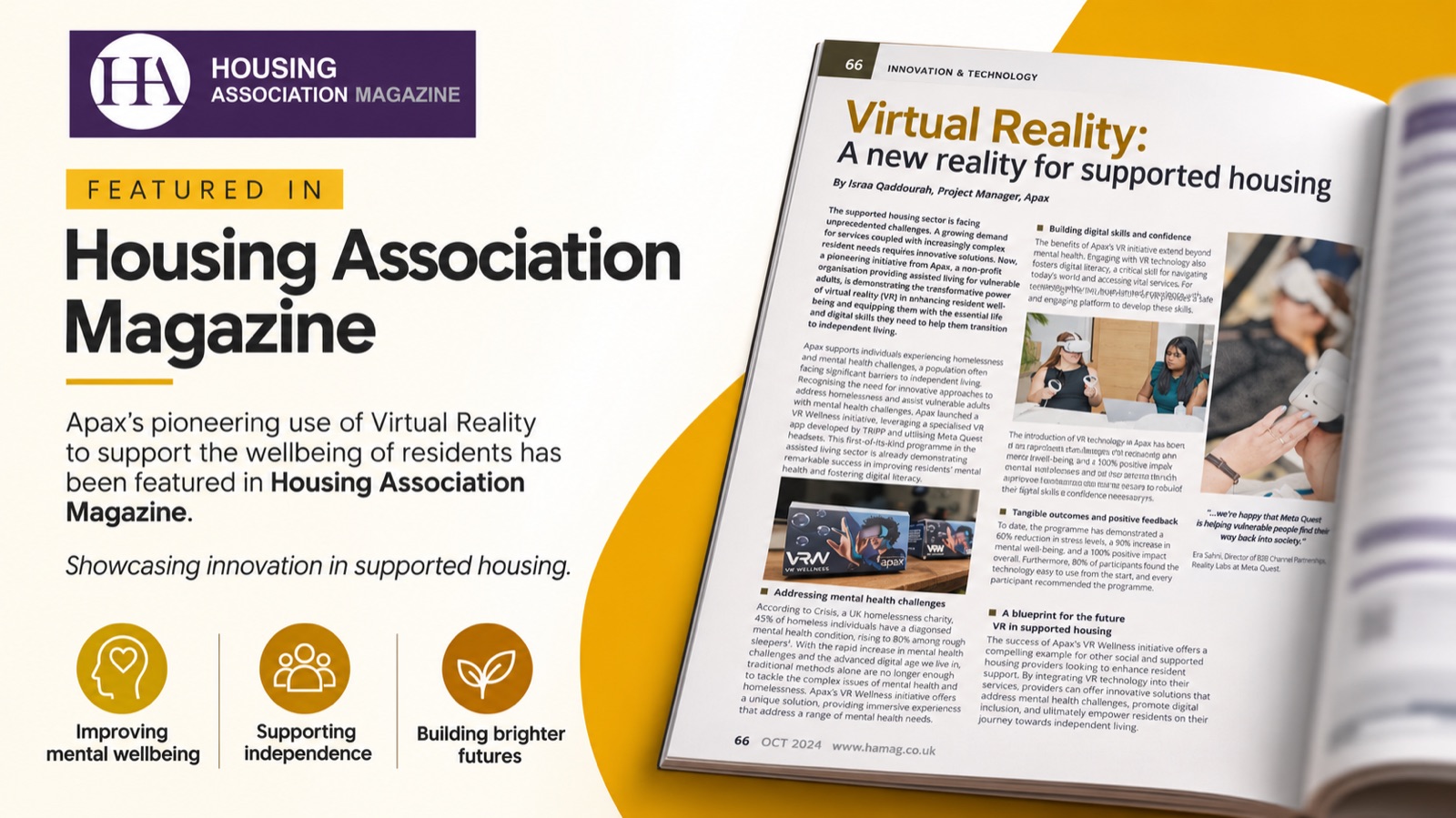
In October 2024, Housing Association Magazine published an article on page 66, in its Innovation and Technology pages, by Israa Qaddourah, Project Manager at Apax. Apax is a supported housing social enterprise in Lewisham, South East London, and the article described its VR Wellness initiative.
The article closed with a section on VR in supported housing as a blueprint for the future. This piece takes up that thought, and asks what other providers might find useful if they are considering something similar.
A Shared Set of Challenges
Supported housing providers across the country share many of the same hopes. They want residents to feel safe, to grow in confidence and, where possible, to move on to settled, independent lives. Those hopes connect providers large and small.
They also share many of the same pressures, from limited time to the wide range of needs that residents bring with them. Ideas that work in one setting can therefore be worth exploring in another. Learning from one another is a natural response.
No single approach will suit every organisation. What travels well between providers is rarely a finished model. It is more often a set of principles that each team can adapt to its own residents.
What the Article Described
The article described how Apax introduced a VR Wellness initiative for residents who have experienced homelessness and mental health challenges, using a specialised VR app developed by TRIPP together with Meta Quest headsets. It set out the aims of the initiative and the experience of introducing it.
It also explained how engaging with VR can help residents build digital skills, alongside its focus on wellbeing. Both are useful foundations for anyone preparing for independent living. Wellbeing and skills often grow side by side.
Our guide to virtual reality in mental health support explains more about the technology itself. Here, the focus is on the wider lessons a provider might draw from the experience.
Begin With Residents
The first lesson is perhaps the simplest. Any new idea should start with the people it is meant to help, their needs, their worries and their sense of what might make a difference. Starting there keeps everything else in proportion.
Inviting residents to try something, rather than presenting it as a requirement, sets the right tone. It signals respect and gives people the freedom to decide whether a new tool suits them. Choice is a form of respect in itself.
Residents' feedback then becomes the guide. Their honest views, shared in their own words, are the clearest indication of whether something deserves a place in everyday support.
Choose Partners Thoughtfully
Few supported housing providers have specialist technical teams. Working with partners who understand the technology can make adoption far more manageable, from choosing the right equipment to setting it up smoothly. Good partners also help a provider to ask the right questions.
The article featured a comment from Era Sahni of Reality Labs at Meta, welcoming the role Meta Quest was playing in helping vulnerable people back into society. Partners like these bring expertise that a small team could not easily build alone.
The best partnerships are built on shared purpose. When everyone involved agrees that residents come first, practical decisions about equipment, software and timing become much easier to make. Shared purpose also makes difficult conversations easier.
Prepare the Team
Technology in supported housing is usually introduced by the people residents already know. Staff who feel confident and well informed are far better placed to offer something new with warmth and reassurance. Their reassurance can make a new idea feel safe to try.
That preparation does not need to be elaborate. Time to try the equipment, space to ask questions and a clear sense of why the programme matters can make all the difference. Small, practical steps are usually enough.
When staff believe in the purpose, residents tend to sense it. Enthusiasm offered gently, without pressure, can encourage people who might otherwise hold back from trying something unfamiliar. Belief is quietly contagious.
Look for Lasting Benefits
When weighing up a new idea, it helps to look beyond the moment. The most valuable programmes leave people with something they can carry forward, whether that is calmer habits, new skills or renewed confidence. Short-term novelty is rarely enough.
Digital skills are a good example. Once someone feels at ease with one kind of technology, that comfort can help with many other parts of daily life, from staying in touch to finding information. Those everyday gains can be just as valuable as the headline ones.
Thinking about lasting benefits also helps providers decide where to focus their time and resources. A small programme that genuinely changes how people feel about themselves can be more worthwhile than a large one that does not.
A Blueprint to Adapt
A blueprint is a starting point rather than a finished building. Each provider will shape these ideas around its own residents, staff and community, and will learn things along the way that are worth passing on. Every provider has something to add.
Apax is grateful to Housing Association Magazine for the chance to share its experience with readers across the sector, and hopes others will feel encouraged to explore what might work for them.
You can read the full article in Housing Association Magazine: Virtual Reality: A new reality for supported housing.